Every contracting company—regardless of trade—accumulates valuable knowledge: how work gets done, what happened on past projects, which procedures matter, what experienced employees have learned, and why important decisions were made.
The problem is that this knowledge rarely lives in one place.
It is scattered across project folders, documents, jobsite photos, text messages, email, software platforms, and the memories of owners, managers, foremen, estimators, technicians, and office staff. When someone needs an answer, they often have to search several systems—or interrupt the one person who might remember.
AI knowledge management for contractors is the process of capturing a company’s project history, procedures, documents, photos, decisions, and employee experience—and making that knowledge searchable and usable by authorized employees.
Contractor Brain™ is being built specifically for that purpose across the contracting industry. It is not electrical-only software. It is a company memory and intelligence system for general and specialty contractors, with each company’s own trade knowledge, terminology, records, and operating methods at its center.
Your company already knows the answers. Contractor Brain helps make sure your people can get them.
Join the Contractor Brain launch listWhy contractors lose valuable company knowledge—and company value
Most contractors do not have a knowledge problem. They have an access and retention problem.
The answer may already exist, but it is buried in a proposal, remembered by a project manager, written in an old service report, photographed on a jobsite, or stored in software the field employee cannot easily search.
When that knowledge lives primarily inside employees’ heads or scattered systems, it has not truly become a lasting company asset. It can be forgotten, become inaccessible, or leave the company entirely when an experienced employee retires or moves on.
This creates familiar problems:
- Crews wait while someone searches for information.
- Owners and managers answer the same questions repeatedly.
- Experienced employees become bottlenecks.
- Project lessons are forgotten instead of reused.
- Troubleshooting history disappears between service calls.
- New employees must relearn lessons the company has already paid to learn.
- Important knowledge leaves when an employee retires or moves on.
- The business becomes harder to scale, transfer, or sell because too much of its value depends on a few individuals.
A contractor with accessible, reusable organizational knowledge is more resilient and potentially more valuable than one that depends on the memories of its owner and a handful of experienced employees.
Company knowledge becomes a true company asset only when the company can retain it, find it, trust it, and reuse it.
When knowledge walks out the door, part of the company’s value walks out with it.
What counts as contractor company knowledge?
A contractor’s organizational knowledge includes much more than formal policies and manuals. It can include:
- Project history, scope, exclusions, changes, and lessons learned
- Proposals, plans, specifications, closeout records, and service reports
- Company procedures, safety practices, forms, and checklists
- Customer preferences, site-access instructions, and operating restrictions
- Jobsite photos, equipment labels, and documented conditions
- Troubleshooting history and previously successful solutions
- Estimating, purchasing, scheduling, and warranty practices
- Crew instructions, field notes, and approved project decisions
- The practical experience carried by owners and long-term employees
Together, these records form the company’s memory. When organized, protected, and made usable, that memory becomes contractor company intelligence.
Built for contractors across the trades
The trade changes. The knowledge problem does not.
Electrical, plumbing, HVAC, mechanical, low-voltage, fire-protection, roofing, general, and other specialty contractors all depend on practical knowledge accumulated through real work. Contractor Brain is intended to provide the common company-intelligence foundation while respecting the differences between trades.
Electrical
Circuit history, concealed conditions, inspections, service findings, scope decisions, and troubleshooting.
Plumbing
Pipe routes, shutoff locations, recurring leaks, equipment history, repairs, and site conditions.
HVAC & mechanical
Equipment history, diagnostic readings, service outcomes, recurring failures, and maintenance knowledge.
Low voltage & fire protection
Cable routes, device history, labeling, test results, deficiencies, and inspection records.
General construction
Sequencing, subcontractor coordination, changes, field decisions, punch work, and closeout details.
Other specialty trades
The project details, company methods, exceptions, and field experience that generic software does not know.
Supporting many trades does not mean treating their technical requirements as interchangeable. Each regulated trade has its own authoritative sources, safety requirements, terminology, and qualified judgment. Contractor Brain’s common role is to preserve and retrieve the company’s authorized knowledge while respecting those trade-specific boundaries.
From scattered information to company intelligence
AI can help contractors do more than store information. It can help connect information and retrieve the right context when someone asks a real operational question.
A useful contractor knowledge system should be able to:
- Capture information through practical inputs such as text, voice, photos, and files.
- Organize information by company, project, customer, topic, date, and source.
- Preserve the original source and important context.
- Respect company and employee permissions.
- Retrieve the most relevant company knowledge for a question.
- Explain where important answers came from.
- Improve as the company adds, reviews, and corrects information.
The goal is not to make employees learn another complicated software workflow. The goal is to let them ask the kinds of questions they already ask every day.
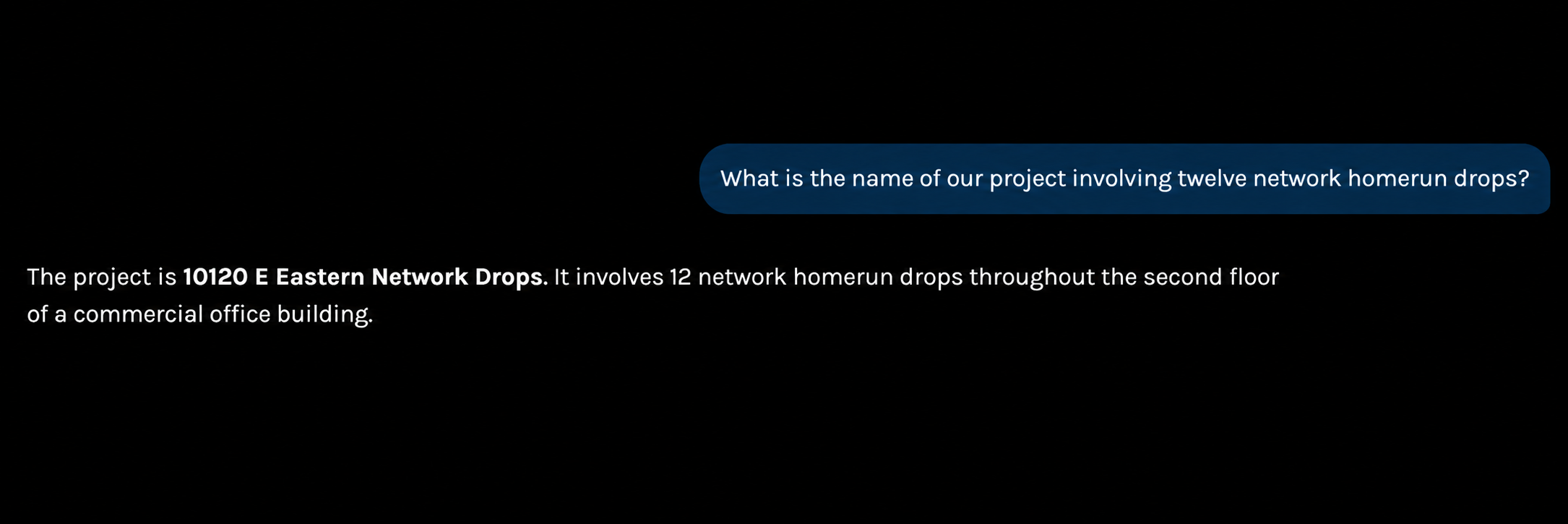
Questions a contractor knowledge system should answer
Examples include:
- What are we doing today on this project?
- What was included—and excluded—in our proposal?
- What did the last technician find at this location?
- Have we solved this equipment problem before?
- What access restrictions or shutdown requirements apply here?
- Which company procedure covers this situation?
- What did we learn from the last project like this one?
- Where did this instruction or project fact come from?
The value is not merely producing an AI response. The value is returning a useful company answer, supported by authorized company information.
How this helps people in the field
Field knowledge loses value when it cannot reach the field.
Technicians and crews often need an answer while standing at a project, not later when they can search through folders at the office. A contractor-focused system should make company and project knowledge accessible through a straightforward field experience, including mobile-friendly questions, voice input, photos, and clear answers.
This can reduce routine office calls, shorten searches, preserve jobsite context, and help employees act with more of the company’s accumulated experience behind them.
It does not replace the judgment of qualified people. It gives those people better access to the company information needed to exercise that judgment.
Turning each workday into a company asset
A written procedure explains how a company intends work to be performed. Some of the most valuable knowledge appears when that procedure meets a real project or service call.
It includes why the planned sequence changed, which assumption proved wrong, what condition was hidden, which troubleshooting step isolated the problem, what solution worked, what failed, and what the next tradesperson needs to know. Those details often remain only in the memory of the technician, foreman, estimator, or project manager who was there.
If that experience stays in one person’s head, truck, phone, or text thread, the company paid to learn it but did not fully retain it.
Contractor Brain’s goal is to make it practical for employees to “download the day” before that knowledge disappears. A short voice note, typed summary, photo, or guided conversation can capture what was expected, what actually happened, what worked, what failed, what decision was necessary, and what the next person should know.
This may require a company behavior change. Useful field knowledge must be treated as part of completing the work—much like entering time, documenting progress, or uploading required photos. The system should make that habit easier through mobile access, voice capture, contextual prompts, and focused follow-up questions.
The true value is not the number of files stored. It is the accumulated explanation of how the company gets work done, how those methods performed in real conditions, and what its people learned along the way. Retaining that knowledge can improve continuity, training, troubleshooting, and decision-making while making the business less dependent on a few individuals.
Preserving project history and tribal knowledge
Every completed project creates knowledge. Much of it is never formally recorded.
A foreman may know why an installation changed. A service technician may remember the real cause of a recurring failure. An estimator may know which assumption shaped a proposal. An owner may carry decades of unwritten customer and operating knowledge.
Contractor knowledge management should make it easier to capture that experience during normal work and connect it to the right project, process, customer, or company topic.
Over time, this creates organizational memory that can help with training, troubleshooting, planning, estimating, project execution, and decision-making.
Company knowledge must remain company-owned
Useful company intelligence requires trust.
Contractor Brain is being designed around four foundational controls:
- Company ownership: The company’s information remains a company asset.
- Company isolation: One company’s knowledge must remain separate from every other company.
- Role-based access: Employees should receive only the information they are authorized to use.
- Source attribution: Important answers should show the company sources that support them.
Public AI and public internet content are not substitutes for a contractor’s private company knowledge. Sensitive customer, employee, financial, project, and operational information requires clear boundaries and accountable access.
Read more about company ownership, permissions, and security.
AI knowledge management versus a generic AI chatbot
A generic AI assistant can explain broad concepts, help draft text, and answer general questions. It does not automatically understand a contracting company’s private history, projects, procedures, permissions, or operating habits.
Contractor Brain is being built around a different question:
How can a contractor make the company’s own knowledge useful to its own people?
That distinction matters.
| Generic AI assistant | Contractor company-intelligence system |
|---|---|
| Primarily knows general information | Uses authorized company and project knowledge |
| Has no automatic understanding of company history | Builds usable organizational memory over time |
| May lack company-specific sources | Connects important answers to company sources |
| Does not inherently know employee permissions | Adjusts company answers to authorized access |
| Helps an individual complete a task | Helps a company retain and reuse what it knows |
Contractor Brain is not intended to replace estimating, accounting, scheduling, project-management, or service software. Those systems run important parts of the business. Contractor Brain’s role is to help make the knowledge spread across the company, its people, its projects, and approved systems easier to understand and use.
Built from inside a real contracting company
Built from decades of firsthand experience inside a working contracting company.
Contractor Brain began inside an electrical contracting company and is being built for contractors across the trades. The product grew from a problem lived firsthand: valuable company knowledge was scattered across people, project records, photos, files, and disconnected systems.
The objective is straightforward:
Retain company knowledge. Provide useful answers.
Contractor Brain is being developed for contractors who want to preserve their company’s experience, reduce repeated searching, and make hard-earned knowledge useful to the next employee and the next project.
Learn how Contractor Brain was built from inside a real contracting company.
Frequently asked questions
What is AI knowledge management for contractors?
AI knowledge management for contractors uses artificial intelligence to help capture, organize, retrieve, and apply a contracting company’s private project history, procedures, documents, photos, decisions, and employee experience. The objective is to give authorized employees useful company-specific answers without forcing them to search across many disconnected sources.
What is company memory for contractors?
Company memory is the accumulated knowledge a contractor has developed through its people, projects, documents, decisions, photos, procedures, and operating history. It includes both formal records and practical tribal knowledge that may otherwise disappear over time.
Is Contractor Brain a construction-management system?
No. Construction-management software typically focuses on running projects through schedules, budgets, documents, workflows, and communication. Contractor Brain is being built to make the company’s accumulated knowledge and project history easier for authorized employees to retrieve and use. It can complement operational systems rather than replace them.
How is Contractor Brain different from ChatGPT or another general AI assistant?
General AI assistants primarily work from broad model knowledge and information provided during a conversation. Contractor Brain is being designed around a contractor’s authorized company knowledge, organizational memory, project context, permissions, and sources.
Can field employees use Contractor Brain?
Contractor Brain is being designed for both office and field use. The goal is a simple, mobile-friendly experience where authorized employees can ask practical questions and contribute useful information through text, voice, photos, and files.
Is Contractor Brain only for electrical contractors?
No. Contractor Brain began from experience inside an electrical contracting company, but it is being built for general and specialty contractors across the trades. The company-intelligence foundation is shared, while each company’s own trade knowledge, procedures, terminology, permissions, project records, and authoritative sources remain specific to that contractor.
Does Contractor Brain own the company information added to it?
No. Company information remains the company’s asset. Contractor Brain is being designed with company isolation, role-based permissions, protected access, and source traceability as foundational requirements.
Can AI replace an experienced contractor or technician?
No. AI does not replace trade qualifications, professional judgment, supervision, code requirements, manufacturer instructions, or project-specific engineering. A useful company-intelligence system helps qualified people find and apply relevant company knowledge more effectively.
Make your company’s knowledge usable
No matter the trade, your company has already paid to learn what it knows—through years of projects, service calls, decisions, corrections, and experience.
Contractor Brain is being built to help preserve that knowledge and make it available to the right people when they need it.
Join the launch list for product updates, early-access opportunities, and the public release.
Join the Contractor Brain launch list